
A copyright claim letter about a picture on your school website: what to do
By Steve Benton, Computer Science teacher and developerUpdated
A letter has arrived saying a picture on your school's website, or in a newsletter, belongs to someone else, and asking for money. It is unsettling, but it is a known problem with known steps. Here they are, in order.
This is general information, not legal advice. Every letter is different. Before you reply or pay, talk to your trust's or local authority's legal team, or a solicitor.
The letter
What these letters are
Picture libraries use specialist claims companies that run image searches across the web and send the owner of each website a long, templated letter asking for compensation. A schools law firm, VWV, wrote in January 2026 that it is often asked to help schools with these claims, commonly over pictures used in newsletters or on websites.
Copyright in the UK is automatic: there is nothing to register, and a picture belongs to whoever made it, or whoever they passed the rights to, whether or not it shows a watermark or a notice (gov.uk: how copyright protects your work). So a picture copied from a search engine, a news site or another school's website usually belongs to someone.
What to do
First steps, in order
- 01
Do not ignore it, and do not pay the same day. A letter that is ignored rarely goes away. If it sets a deadline, that is a reason to get advice quickly, not to pay without it.
- 02
Check the letter is genuine. Look the company up yourself, not through the links, phone numbers or bank details in the letter or email. Then check that the picture really is, or was, on your website or in your documents.
- 03
Find the picture and everywhere it is used. Note the page or document, the newsletter it went out in, and when it was first published if you can tell. The same picture is often in more than one place.
- 04
Take screenshots, then take it down. Screenshot each place it appears, with the address and the date, then remove or replace the picture and record the date you did. Taking it down stops the use going on; it does not by itself settle a claim about the time it was up.
- 05
Find out where it came from. A member of staff's presentation, a template, a supplier who built the website, or a picture library you paid for. Look for a receipt, a licence or an email that shows where it came from.
- 06
Get advice before you reply. Talk to your trust's or local authority's legal team, your school's legal adviser or a solicitor before you reply, admit anything or pay. Keep every letter and email.
Who to tell
Who to tell
- the headteacher and the school business manager, the same day;
- your trust's central team or the local authority, who may have a legal team and may have seen the same company before;
- your insurer, or the DfE's risk protection arrangement if your school is a member: check what your cover includes before you assume either way;
- your website provider, if they built the pages or supplied the picture;
- the member of staff whose document it was, kindly: the aim is to find where the picture came from, not to blame anyone.
Schools and the law
Why the teaching exceptions rarely help
Copyright law has exceptions for education, in sections 32 to 36A of the Copyright, Designs and Patents Act 1988. VWV notes that they tend to be read narrowly, and that a picture from the internet used in a newsletter is unlikely to fall within them. The IPO's guidance on exceptions says the illustration exception is for use “solely to illustrate a point”, not for commercial purposes, with a sufficient acknowledgement, and only where the use is fair dealing.
The copying licences the DfE buys for state-funded schools in England do not usually help either. Gov.uk says images copied under them are covered “for internal distribution within the school, but not for sharing on a public facing website” (copyright licences for state schools in England).
And no watermark does not mean free to use. VWV calls that “a common misconception”.
Next time
Preventing the next one
- Use your own photos where you can.
- Where you need other pictures, use a library you have a licence for, and keep the receipt or licence with a note of where each picture is used.
- Keep a simple picture register: what each picture is, where it came from and where it is used.
- Remember the documents. Old presentations, knowledge organisers and newsletters on the website hold pictures too, and they are the easiest to forget.
- Ask your website provider what pictures came with the site's templates and whether they are licensed for your use.
How School Checkup helps
Find the pictures worth checking before a letter does.
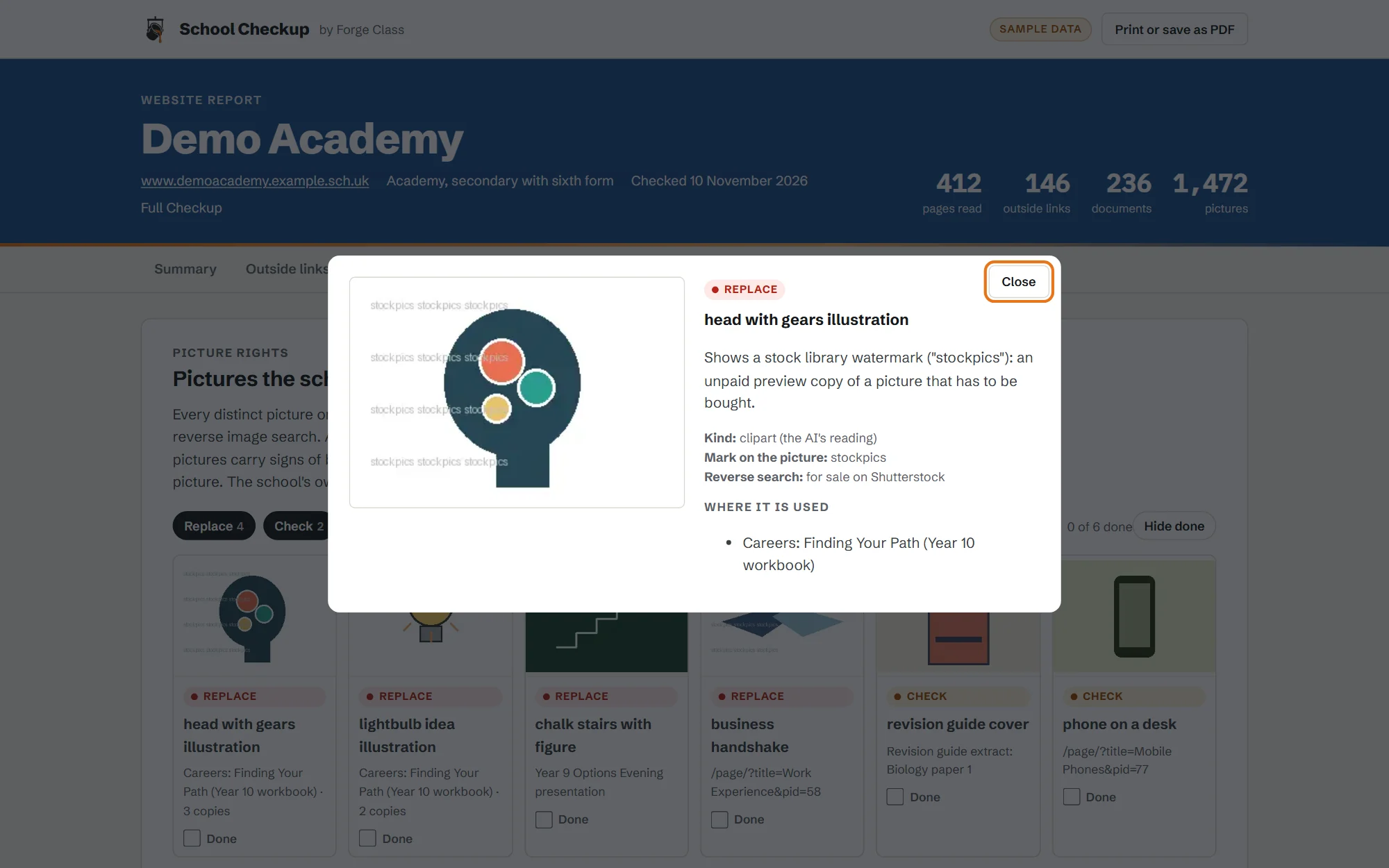
School Checkup's picture rights check builds that register for you. It finds every distinct picture on your pages and inside the PDF, Word and PowerPoint files your site hosts, and runs a reverse image search on each one to see whether it is for sale on a stock library. Each picture is labelled replace or remove, check, or nothing found, with the page or document it is in.
A computer cannot prove whether you bought a licence, so it cannot promise you will never get a letter. It shows you the short list of pictures that carry signs of belonging to someone else, so you can check those first.
Questions
Is it a scam?
Some letters are genuine: picture libraries use companies that search the web for their pictures and send the website's owner a claim. Treat it as possibly genuine, but check it yourself before you reply or pay, using contact details you found independently.
Should we just pay?
Get advice first. Where a picture really was used without permission, a schools law firm notes that such claims are often difficult to dispute, so take the letter seriously. But find out what you are being asked to pay for, and whether it is right, before you settle.
Does taking the picture down end the claim?
Not by itself. It stops the use going on, and you should do it straight away, but the claim is about the time the picture was up. Record the date you removed it.
Can schools use images from Google?
Not just because they appear in search results. Copyright in the UK is automatic, so a picture usually belongs to someone even with no watermark or copyright notice. Use your own photos, pictures you have a licence for, or pictures whose licence allows your use, and keep a record.
Does the school's copying licence cover our website?
Usually not. The DfE buys copyright licences for state-funded schools in England, and gov.uk says images copied under them are covered for internal distribution within the school, but not for sharing on a public facing website.
Would the teaching exceptions in copyright law cover us?
Rarely, for a website. The exceptions in sections 32 to 36A of the Copyright, Designs and Patents Act 1988 are read narrowly, and the illustration exception is for teaching, with an acknowledgement, not for publishing to the world.
Sources
- VWV: A reminder for schools to be alert to copyright infringement (22 January 2026)
- Gov.uk: How copyright protects your work
- Gov.uk (Intellectual Property Office): Exceptions to copyright
- Gov.uk: Copyright licences for state schools in England
- Copyright, Designs and Patents Act 1988, on legislation.gov.uk
- The Intellectual Property Office, on gov.uk
- Checked on 17 November 2026. This page is general information, not legal advice.
Check the pictures on your school website. The first check is free.